Fixed structures for photovoltaic plants: MFR solutions for efficient solar projects
Fixed photovoltaic structures are one of the most established solutions for the development of solar plants on the ground. Their design allows for the stable, safe installation of photovoltaic modules, adapted to the specific conditions of each project, optimizing both solar capture and the durability of the installation.
What is a photovoltaic fixed structure?
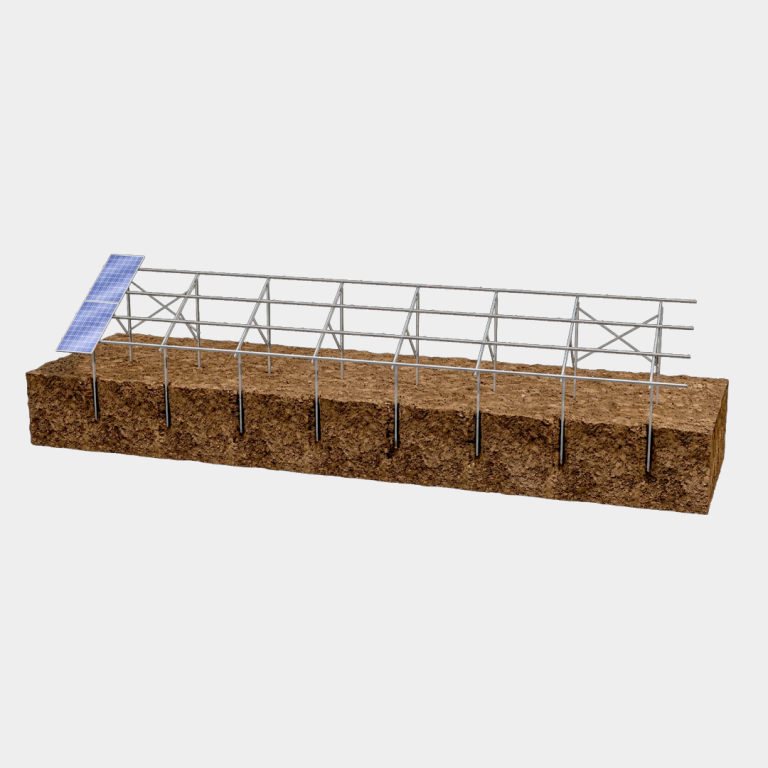
A fixed photovoltaic structure is a support system designed to keep the solar panels in a specific position, with a defined inclination and orientation according to the needs of the solar plant.
Unlike solar trackers, fixed structures do not change their position during the day. Their main advantage is that they offer a robust, simple, and efficient solution for projects where a stable, low-maintenance structure is sought that adapts to the available terrain.
This type of solution is commonly used in ground-mounted photovoltaic plants, industrial projects, large-scale self-consumption installations, and solar developments where the priority is to combine efficiency, durability, and cost optimization.
Fixed structures MFR: adaptability for every solar project
Metal Frame Renovables’ fixed ground structures adapt to any model of photovoltaic module, panel layout and terrain typology. This flexibility allows the development of customized solutions based on the actual conditions of the site and the technical requirements of each installation.
At MFR we work with the Monoposte and Biposte solutions, two versatile configurations that allow us to meet different design, assembly, and structural behavior needs.
Monoposte structure
The Monoposte structure is characterized by using a main support line, which allows for efficient installation and an optimized solution for certain terrains and plant configurations.
It is an especially interesting alternative when the goal is to simplify assembly, reduce structural elements, and maintain a solution that is robust and adapted to the project.
Biposte structure
The Biposte structure incorporates two support lines, providing greater stability in configurations that require a different structural distribution or specific adaptation to the terrain.
This solution is suitable for projects where load conditions, module layout, or terrain characteristics require a more robust configuration.

Advantages of fixed structures for photovoltaic plants
Fixed structures continue to be one of the most widely used solutions in the solar sector due to their technical balance, competitive cost, and reliability.
1. Design adapted to the terrain
Each photovoltaic plant has different conditions: soil type, slope, wind loads, snow loads, orientation, access, and module configuration.
That is why at MFR we carry out a technical study to define the most suitable structural solution in each case. The goal is to ensure that the structure responds correctly to the project requirements and facilitates a safe and efficient installation.
2. Compatibility with different photovoltaic modules
The MFR fixed structures are designed to adapt to different formats and arrangements of the FV modules. This compatibility facilitates the work of developers, engineers, and installers, allowing the structural solution to be adjusted to the electrical and energy design of the plant.
3. Robust and reliable solutions
The structure is an essential part of any photovoltaic installation. Its function is not only to support the modules, but also to ensure their stability in the face of the environmental and mechanical conditions of the site.
At Metal Frame Renovables, we work with materials and processes oriented towards the quality, strength, and durability of each structural system.
4. Optimization of the assembly
A well-designed structure helps to reduce installation times, simplify logistics, and facilitate work on-site. MFR fixed solutions are developed taking into account both structural calculations and real on-site assembly experience.
This allows us to offer systems designed for photovoltaic projects of different scales, from medium-sized installations to large solar plants.
5. Low maintenance
Since these systems are non-moving, fixed structures require reduced maintenance compared to other more complex solutions. This makes them an attractive option for projects where operational reliability and long-term stability are sought.

When to choose a fixed photovoltaic structure?
The fixed structure is an especially suitable option when the project seeks:
A robust and stable solution for ground-mounted solar plants.
A low-maintenance system.
A structure compatible with different module configurations.
A technically optimized solution for the available terrain.
A competitive cost compared to systems with motion.
A simple and reliable installation.
This type of structure is common in projects where the priority is to ensure the stability of the system, optimize investment, and ensure good performance throughout the entire life of the plant.
Conclusion: MFR fixed structures for safe and efficient solar projects.
Fixed photovoltaic structures are a key solution for the development of ground-mounted solar plants. Their robustness, ease of assembly, low maintenance requirements, and adaptability make them an efficient alternative for projects of different scales.
At Metal Frame Renovables, we design, manufacture, supply, and install fixed structures adapted to the terrain, the type of module, and the specific needs of each installation. Our goal is to offer reliable, competitive structural solutions prepared to meet the demands of today's photovoltaic sector.
Do you need a fixed structure for your next photovoltaic project?
At Metal Frame Renewables We study each project individually to offer the most suitable structural solution.
Visit our page for more information: https://www.mfrenovables.com/estructura-fija-mfr/
Contact our technical team and discover how we can help you with the design, calculation, manufacture and supply of your photovoltaic fixed structure.