

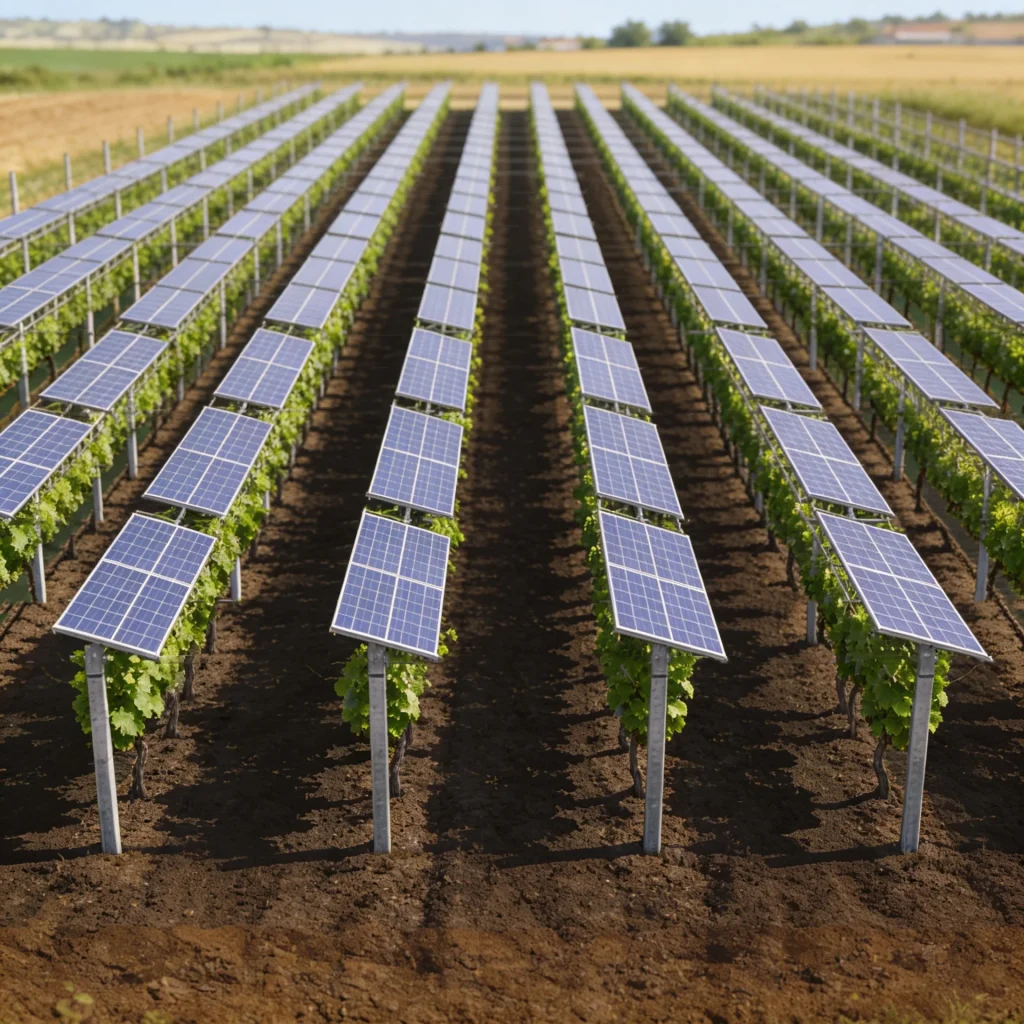

Agrovoltaics has proven to be an effective solution for combining the production of
solar energy and agricultural activity, but its development does not stop there. As
As climate challenges and demand for clean energy increase, so do
opportunities for innovation. In this article, we explore the trends and
technological innovations that will shape the future of agrovoltaics.

One of the most promising advances is the development of semi-transparent solar modules, designed to allow some of the sunlight necessary for crops to pass through. These panels improve photosynthesis and maximise efficiency in both food production and energy generation.
Thin-film photovoltaic modules: Less invasive and lighter, ideal for shade-sensitive crops.
Adjustable solar tracking technology: Allows the orientation of the modules to be changed according to the needs of the crop and the available solar radiation.
In pilot projects in France and Germany, these panels have increased the yield of certain crops by up to 15%, while maintaining high energy production.
Optimising water use is essential for agricultural sustainability, especially in regions affected by drought. The future of agrovoltaics will include automated irrigation systems integrated with sensors that monitor soil moisture in real time and adjust irrigation according to needs.
Smart humidity and temperature sensors: Real-time data to optimise water consumption.
Rainwater harvesting systems: Reuse of collected water for irrigation.
These advances are already being implemented in some vineyards in Spain, where water consumption has been reduced by 20% without affecting production.


The bifacial modules, which capture sunlight on both sides, are one of the main technological innovations in agrovoltaics. These modules increase energy efficiency by harnessing light reflected from the ground or crops.
Higher energy generation per square metre.
Reduced visual impact, as fewer modules are required to obtain the same amount of energy.
In Japan and China, the implementation of bifacial modules has increased energy production by 10-20%, improving project profitability.
The future of agrovoltaics will also be marked by the use of digital platforms and advanced management software. These tools will enable the monitoring and optimisation of both agricultural production and energy generation, integrating real-time data and weather forecasts.
This predictive analysis based on meteorological data will help plan
irrigation, harvesting and general agricultural work.
These platforms are already being used in pilot projects in the United States and are facilitating more informed and profitable decision-making.
As renewable energy generation increases, so does the need to store this energy efficiently. The future of agrovoltaics will include the integration of advanced batteries and other storage technologies that will enable the energy generated to be used even when the sun is not available.
Long-life lithium-ion batteries.
Green hydrogen energy storage: A sustainable option for large projects.
In remote regions, these solutions will enable rural communities to supply themselves with clean energy throughout the day and night.

The future of agrovoltaics also lies in crop diversification and in its application in agroforestry systems, where solar modules coexist with trees and perennial plants.
Specialised crops and organic products.
Combination of photovoltaic modules with forest plantations to increase carbon capture and promote biodiversity.
In countries such as Italy and France, this combination is already being explored to maximise agricultural and environmental benefits.
Agrovoltaics is constantly evolving, driven by technological advances and
new applications that promise to improve their efficiency and sustainability. With
innovations such as semi-transparent panels, smart irrigation systems and
energy storage, its potential to transform agriculture and
energy generation is immense. This is just the beginning of a revolution that
could redefine land use and sustainable production.
In future publications, we will continue to explore investment opportunities and
success stories in these new applications.

Te informamos de que los datos que nos facilites serán tratados por METAL FRAME RENOVABLES S.L. para atender tu consulta o solicitud. La base legal es tu consentimiento. No se cederán datos a terceros, salvo obligación legal o proveedores necesarios para la prestación del servicio. Puedes ejercer tus derechos escribiendo a info@mfrenovables.com. Más información en nuestra Política de Privacidad.